
What Is Positive Reinforcement Dog Training: An Interview with Kate Walsh, Lead Trainer at Far Fetched Acres
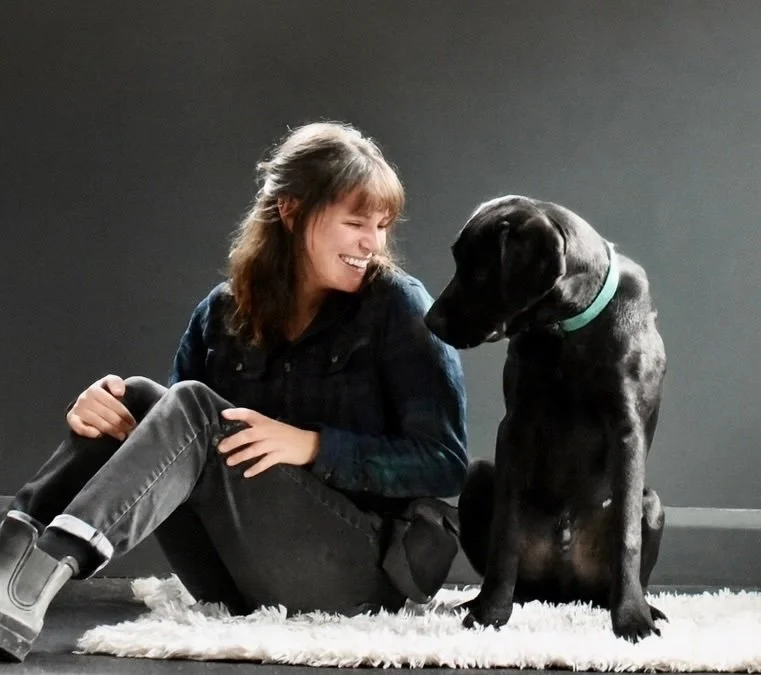
Tell me about your background as a trainer.
Kate: My family would volunteer as puppy raisers for dogs who were in a guide dog program. We would get them at eight weeks old and raise them until they were two years old. So, over and over again, I got to watch the cycle of development, all the way from tiny baby behaviors to adolescence when things get tough. It was a really great experience for me. I started my own walking and training business in 2018. I got certified through Karen Pryor Academy in 2021 and have been training full-time ever since.
How long have you been at Far Fetched Acres?
Kate: Just over a year. It’s pretty impossible to find a fully force-free and positive-reinforcement-based board and train program, but it exists. And now I get to lead the programs, which is really cool.
At Far Fetched Acres, your training philosophy revolves around positive reinforcement. What is positive reinforcement dog training?
Kate: Positive reinforcement training is adding something that the learner enjoys, following a specific behavior, in order to strengthen the probability that you will see that behavior again. And that's a very scientific operant conditioning way to put it. But that is the quadrant of learning that we focus on most heavily. There's no anticipation of a punishment or having to have something removed from them. It is just “try something once, see if it works.” If it works, great, try it again. If it doesn't work, try something else.
What does positive reinforcement dog training look like in practice?
Kate: One of the biggest priorities for me is environment arrangement. So, setting a dog up to have the opportunity to make correct choices is just as valuable to me as reinforcing when they do make a correct choice. For example, if you are working with a dog who's practicing polite greetings, you may want to have the guest sprinkle a couple of treats on the floor to encourage the dog to stay low while the guest leans down to pet them. And then you can reward them for the fact that they kept all four of their feet on the floor.
So positive reinforcement dog training involves setting the dogs up for success?
Kate: Correct. Most of the time, dogs’ natural choices aren't necessarily the ones that blend best into our world. If you can set them up to make a good choice, they're more likely to make that good choice. Same thing if you set them up to fail by leaving a big steak out on your countertop, they are going to jump up onto your counter. So, if you can tap into what makes the most sense to that dog and then set them up appropriately, they're more likely to make good choices.
Some owners worry that positive reinforcement doesn't correct bad behavior. I'd be interested to know how you and Far Fetched Acres as a whole would respond to that.
Kate: I like to believe that every dog has a piggy bank for every behavior they perform. Whether it's food, access to something, or a natural reinforcement such as, "I jumped up on the counter and there happens to be a steak and now I got rewarded for jumping up on the counter." If we are trying to build what's called an alternative behavior to jumping up on the counter, that may look like laying calmly on a mat on the floor next to the counter. We want to fill that piggy bank up so that the reinforcement history from that piggy bank outweighs the reinforcement history that comes from self-reinforcement of behaviors that we don't love.
How do you handle it when a dog doesn't respond as expected?
Kate: It's important that we take information from a failed repetition and say, "Okay, so what was it about that moment that was harder for you than others and that caused you to make a different choice than the one we're looking for?" It may be that we stepped up our challenge level too quickly and we put the dog in a situation that they weren't able to make a good choice in, in which case we reel back and we say: "Okay, this is our pause moment. We need to break the next step into four or five baby steps so that we can actually piece out what part of this challenge is so hard for you."
What are the benefits of positive reinforcement dog training over using a combination of methods?
Kate: I think you will find your most confident and creative and curious learners are the ones that learned through positive reinforcement, because they don't have to fear an uncomfortable consequence as an outcome of their behavior. There can be all kinds of emotional components that come with learning through fear or punishment that we want to avoid at all costs. We just want to create a happy, well-rounded learner.